I've had a couple of Oregon rosés in the cellar that I purchased far too many years ago and haven't drunk so I decided to pull one out for dinner tonight. I was afraid that the 2003 Adelaida Vin Gris de Pinot Noir was past its prime, but what I didn't expect was the massive whiff of cork taint the emerged as soon as I pulled the natural cork. Ugh.... TCA (trichloroanisole) has finally struck my cellar. Up to now, I honestly don't think I've had an episode of cork taint from one of my purchased wines. But the law of averages has finally snuck up on me.
Too bad, I remember this wine being a lively, crisp, fruity delight back when I sampled it at the winery. Today, it was a shallow husk of a wine. No fruit and wilting under the TCA onslaught.
Let this be a lesson to you all. Drink those rosés now! They're meant for early consumption so don't wait. Find your guy/gal, grab some picnic fare from the grocery store, and enjoy a sunny spring day with a glass of rosé!
Cheers,
Noel
Friday, April 16, 2010
Sunday, April 4, 2010
Italian Wine Course, Class #2
Continuing my wine education, I attended the 2nd of a 6 class series on Italian wines offered by Gordon's Liquors in Waltham, MA last Tuesday, March 30. Michael Murray, one of the wine buyers at Gordon's, taught this class focusing on Puglia, Abruzzo, Marche, & Lazio regions of Italy. That would be regions #1, 7, 10, & 13 on the map (area around Rome and then the back & heel of the boot along the Adriatic Sea). The wines were paired with a Piave & a Tallegio (my favorite) cheeses from Whole F oods. Instead of doing white wines & then red wines, the class was structured by region.
Lazio
The Lazio region has not been known as a region for producing premium wines because of the proximity of Rome. Production has been mostly focused on high volume, inexpensive wines to serve Rome's large population.
Tenuta di Pieta Prozia Frascati Secco "Regillo" 2008 Price: $12
Region: Lazio D.O.C.
Varietal(s): 70% Malbezio, 20% Tebiano, 10% Greco
Review: White wine. Pineapple & floral notes in the nose. Not that special on the tongue. Crisp finish. Not a memorable wine.
Compagnia di Ermes Cesanese di Olevano Romano 2007
Price: $12
Region: Lazio D.O.C. South of Rome
Varietal(s): Cesanese
Review: Red Wine. Chocolate/tobacco, cedar aromas in the nose. Cherry & diesel flavors with a tarry finish.
Marche Region
Coastal, plainer region
Borgo Paglianetto Verdicchio di Matelica 'Aja Lunga' 2007
Price: $19
Region: Marche D.O.C.
Varietal(s): Verdicchio
Review: White Wine. Honeysuckle, pears, & peaches in the nose. good mouthfeel, crisp finish. Tank fermented--no oak. A good white wine!
Pasetti Pecorino Terre di Chieti 2008
Price: $20
Region: Marche I.G.T.
Varietal(s): Pecorino
Review: Floral with hits of green apple & melon. Slightly buttery with a flat oaky finish. Big mouthfeel akin to a chardonnay. Nice, but not great.
Saladini Pilastri Rosso Piceno Superiore "Vigna Montepradone' 2003
Price: $25
Region: Marche D.O.C. (Piceno area)
Varietal(s): 70% Montepuliciano, 30% Sangiovese
Review: Red Wine. Bright cherry flavors with notes of cedar & tar. Big tannins & bright acid. Aged in new French oak barrels. I liked this wine!
Abruzzo Region
One of the most mountainous regions of Italy, Abruzzo grows mostly Montepulciano & trebbiano grapes.
Ducato di San Zeno Montepulciano d'Abruzzo 2008
Price: $8
Region: Abruzzo D.O.C.
Varietal(s): Montepulciano
Review: Medium bodied wine with big cherry & vanilla flavors. Concord-like grapey finish. Simple wine that resembles the price.
Cataldi Madonna Montepulciano d'Abruzzo 2007
Price: $23
Region: Abruzzo D.O.C.
Varietal(s): Montepulciano
Review: Dark raspberry, cherry, tar, & tobacco. Gripping tannins that need some aging. Very surprising to find that this wine has seen no oak. I like it!
Montepulciano Masciarelli 'Marina Cvetic' 2006
Price: $30
Region: Abruzzo D.O.C.
Varietal(s): Montepulciano
Review: Much darker flavors. Big Tannins. Cherries, vanilla, cassis. Michael pulled this off the shelf when the Cataldi Madonna 2007 didn't live up to the tasting of the 2006. By far, the best of the night!
Puglia Region
Taurino Notarpanaro Salento 2003
Price: $20
Region: Salento I.G.T.
Varietal(s): Negero nero
Review: Tobacco & tar in the nose, fruity palette. Tastes much younger than it smells. Yum!
Castello Monaci Primitivo Salento 2007
Price: $12
Region: Salento I.G.T.
Varietal(s): Primitivo/Zinfandel
Review: Tastes like a classic zinfandel. Big cherry & prune/stewed fruit flavors. High Alcohol. Spicy! No oak.
This class touch a nerve, so I ended up purchasing a case of wine (2 each of the 2007 Borgo Paglianetto, 2003 Saladnini Pilastri, 2007 Cataldi Madonna, 2003 Taurino, 2007 Castell Monaci, and 2006 Masciarelli. I'm looking forward to popping these wines open later.
Cheers,
a Wine Student
 oods. Instead of doing white wines & then red wines, the class was structured by region.
Lazio
The Lazio region has not been known as a region for producing premium wines because of the proximity of Rome. Production has been mostly focused on high volume, inexpensive wines to serve Rome's large population.
Tenuta di Pieta Prozia Frascati Secco "Regillo" 2008 Price: $12
Region: Lazio D.O.C.
Varietal(s): 70% Malbezio, 20% Tebiano, 10% Greco
Review: White wine. Pineapple & floral notes in the nose. Not that special on the tongue. Crisp finish. Not a memorable wine.
Compagnia di Ermes Cesanese di Olevano Romano 2007
Price: $12
Region: Lazio D.O.C. South of Rome
Varietal(s): Cesanese
Review: Red Wine. Chocolate/tobacco, cedar aromas in the nose. Cherry & diesel flavors with a tarry finish.
Marche Region
Coastal, plainer region
Borgo Paglianetto Verdicchio di Matelica 'Aja Lunga' 2007
Price: $19
Region: Marche D.O.C.
Varietal(s): Verdicchio
Review: White Wine. Honeysuckle, pears, & peaches in the nose. good mouthfeel, crisp finish. Tank fermented--no oak. A good white wine!
Pasetti Pecorino Terre di Chieti 2008
Price: $20
Region: Marche I.G.T.
Varietal(s): Pecorino
Review: Floral with hits of green apple & melon. Slightly buttery with a flat oaky finish. Big mouthfeel akin to a chardonnay. Nice, but not great.
Saladini Pilastri Rosso Piceno Superiore "Vigna Montepradone' 2003
Price: $25
Region: Marche D.O.C. (Piceno area)
Varietal(s): 70% Montepuliciano, 30% Sangiovese
Review: Red Wine. Bright cherry flavors with notes of cedar & tar. Big tannins & bright acid. Aged in new French oak barrels. I liked this wine!
Abruzzo Region
One of the most mountainous regions of Italy, Abruzzo grows mostly Montepulciano & trebbiano grapes.
Ducato di San Zeno Montepulciano d'Abruzzo 2008
Price: $8
Region: Abruzzo D.O.C.
Varietal(s): Montepulciano
Review: Medium bodied wine with big cherry & vanilla flavors. Concord-like grapey finish. Simple wine that resembles the price.
Cataldi Madonna Montepulciano d'Abruzzo 2007
Price: $23
Region: Abruzzo D.O.C.
Varietal(s): Montepulciano
Review: Dark raspberry, cherry, tar, & tobacco. Gripping tannins that need some aging. Very surprising to find that this wine has seen no oak. I like it!
Montepulciano Masciarelli 'Marina Cvetic' 2006
Price: $30
Region: Abruzzo D.O.C.
Varietal(s): Montepulciano
Review: Much darker flavors. Big Tannins. Cherries, vanilla, cassis. Michael pulled this off the shelf when the Cataldi Madonna 2007 didn't live up to the tasting of the 2006. By far, the best of the night!
Puglia Region
Taurino Notarpanaro Salento 2003
Price: $20
Region: Salento I.G.T.
Varietal(s): Negero nero
Review: Tobacco & tar in the nose, fruity palette. Tastes much younger than it smells. Yum!
Castello Monaci Primitivo Salento 2007
Price: $12
Region: Salento I.G.T.
Varietal(s): Primitivo/Zinfandel
Review: Tastes like a classic zinfandel. Big cherry & prune/stewed fruit flavors. High Alcohol. Spicy! No oak.
This class touch a nerve, so I ended up purchasing a case of wine (2 each of the 2007 Borgo Paglianetto, 2003 Saladnini Pilastri, 2007 Cataldi Madonna, 2003 Taurino, 2007 Castell Monaci, and 2006 Masciarelli. I'm looking forward to popping these wines open later.
Cheers,
a Wine Student

Saturday, April 3, 2010
David Coffaro Bernier's Zin 2003
Was cleaning up my desk earlier this week and came across my tasting notes from this wine. I vaguely remember opening it in early February, probably to enjoy with a nice Saturday evening steak dinner in front of the fireplace. Friends will recognize that David Coffaro is one of my most favorite Sonoma County wineries. I buy their wine through a futures program. The name Bernier's Zin refers to the fact that the grapes were purchased from Paul Bernier & Scott Sibary's vineyard which is located in the Dry Creek Valley.
State: California
Appellation: Dry Creek Valley
Cost: $15 (purchased through futures program)
Appearance: Dark, foreboding black red
Aroma: Cocoa, dark cherries, blackberries, more chocolate
Yummmmm..... One bottle left...
David Coffaro Bernier's Zin 2003

Country of origin: United States
State: California
Appellation: Dry Creek Valley
Varietal: 75% Zinfandel, 10% Petite Sirah, 10% Carignan, 5% Mourvedre
Stats: 14.5% ABV, 365 cases produced
Cost: $15 (purchased through futures program)
Appearance: Dark, foreboding black red
Aroma: Cocoa, dark cherries, blackberries, more chocolate
Taste: Bright Cherries & raspberries, chocolate, mildly tart with moderate tannins. A long, pleasant aftertaste.
Yummmmm..... One bottle left...
Sunday, March 28, 2010
Italian Wine Course, Class #1
My favorite wine shop, Gordon's Liquors in Waltham, MA, recently offered a new series of wine tasting classes with the focus on Italian wines. I readily admit that my knowledge of Italian wines is a little lacking, so I decided to sign up for the entire schedule of 6 classes. Italian wines are a daunting subject since there are >2000 indigenous grape varietals. Historically, the majority of Italian wines have been produced for local consumption, so production & quality standards have not been extremely rigorous. The formation of the Italian appellation system in 1963 served to simply codify existing winemaking practices that may or may not have been the best. Fortunately, globalization has begun to change this fault as winemaking practices are changed to compete on the global market.
The first class was held on Tuesday, March 23 at the Culinary Center in the back of the store. Bob Kaplan had selected the wine and held forth on regional information & wine details. This first class focused on wines from the southern regions of Sicily, Sardinia, Calabria, Basilicata, & Campania (regions #2, 3, 4, 14 & 19 in the map). These areas are less well developed than the northern regions of Italy and the wines are not as prestigious or well-regarded. Consequently, they are less expensive if you find a wine that you enjoy. The wines were paired with a Sottocenere with Truffles & a Pecorino Ginepro cheeses from Whole Foods.
White Wines
La Segreta Bianco ($15)
Region: Sicily IGT
Details: 50% Chardonnay, 10% Viognier, 40% Falanghina
Review: Peaches & citrus in the nose. Tastes of apricot with a honeyed finish. Light bodied (good summer sipper)
Cantina Gallura Vermentino 2007 ($20)
Region: Sardinia DOCG
Review: Golden color, aromas & flavors of apricots, honey, raisins, & caramel. Extremely flat sherry-like finish. Tastes like this wine has oxidized. Not good
Feudi di San Gregorio Falanghina ($19)
Region: Campania, near Avelino
Review: Aromas of pineapple, peaches, apricots, & honeysuckle. Dried apricot finish.
Feudi di San Gregorio Greco di Tufo ($24)
Region: Campania, near Avelino
Review: Light citrus & honeysuckle. Short finish. Tastes similar to a viognier
Red Wines:
Planeta La Segreta Rosso ($15)
Region: Sicily IGT
Review: Dark cherries, rosemary, vanilla. Medium body with a Concord-like grapey finish.
Templum Cannonau ($20) same grape as Granache
Region: Sardinia DOC
Review: Fairly bricked in color. Black cherry, cinnamon, little chalky on the finish. Mild tannins
Planeta Cerasuolo di Vittoria ($23)
Region: Sicily IGT
Review: Cherries, cassis, vanilla in the nose. Big fruity flavors with dancing raspberries, mild tannins, good mouthfeel. Went REALLY good with the Pecorino cheese!
Feudi di San Gregorio Rubrato ($19)
Region: Campania
Review: Very dark lightly bricked color. Blackberries, blueberries, & chocolate with a little tobacco. Big, bold tannins & good mouthfeel.
Librandi Gravello ($35) blend of Cabernet Sauvignon & Delamonto
Region: Calabria, near the town of Churo
Review: Black cherry, raspberries, & currants. Balanced tannins. Chocolate, slightly tart finish.
Cantine dei Notario La Firma 2005 ($50)
Region: Basilicata
Review: Dark cherries, raspberries, light tobacco with soft tannins. Good, just not sure it's $50 good.
Cheers,
a Wine Student
Saturday, March 27, 2010
NE Coastal Wine Trail Weekend Day Two
Sunday, March 21, 2010...
The day dawned on the second day of my Coastal Wine Trail tasting adventure. After a leisurely breakfast at the Hampton Inn Fairhaven and a good work-out in the fitness facility, I checked out of the hotel , made a pit stop at the local Panera Bread for lunch, and then headed to more wineries.
Stop #1: Running Brook Vineyards
Address: 335 Old Fall River Road, North Dartmouth, MA
I didn't know what I would be getting into at this visit. I will admit that I was greatly confused when I pulled in. The OPEN flag was flying at the gate, but no one was in the parking lot in front of the barn-like structure and what appeared to be the front door was locked. I headed back to my truck and started input the address of the next winery into my GPS unit when a truck pulled up. Out hopped a man who turned out to be one of the winery's owners who quickly invited me inside for a tasting. Running Brook is a work in progress. Unlike the other wineries on the trail, this 4-yr old winery is still building it's site of operation and the tasting room is merely a counter top inside the main winemaking area. Not as polished as the other wineries, but very enjoyable since you can see every aspect of the winery--the fermentation tanks, the barrel racks, and the bottling line. The charge for tasting was $7. I think there was a suggested number of wines to taste, but after Pedro discovered that I make wine as well and had an interest in starting a winery, he started pulling out everything he had to taste, including barrel/tank samples!
2007 Chardonnay ($13): Simple dry white wine with light flavor, but a smooth sipping wine
2005 Reserve Chardonnay ($17): Unfiltered & aged for 2 years in old French oak. 100% MLF gave it a nice rich butteriness.
2005 Reserve Chardonnay Unoaked: Nice pineapple nose & crisp finish
2007 Pinot Gris ($14): Bold citrus (pineapple, grapefruit) with a nice crisp finish
2008 Pinot Gris: Unlike the 2007, this wine has not undergone malolactic fermentation, so the flavors are driven by big, green apple aromas.
2007 Cabernet Franc ($18): Finally, a good red wine on the Trial. Lighter color, but big strawberry & black pepper flavors.
2007 Merlot ($18): Very nice. Black cherry & pepper aromas with subtle tobacco. 1.5 years in French oak.
2007 Vidal blanc ($13): Apricot & honey explosion. Semi-sweet finish with a nice balance of sugar & acid (high Brix at harvest).
2008 Vidal blanc: Tank sample. Crisp, Pineapple & Grapefruit predominate.
2009 Vidal blanc: Tank Sample. Still a little cloudy, but gorgeous big honey flavors.
2007 Auslesen ($20): Late harvest vidal blanc made by the traditional German auslesen method of selecting individual high sugar grape bunches. Sweet dessert wine.
2005 Late Harvest Vidal Blanc ($20): Sherry-like with bold apricot aromas and peach & pineapple flavors. Very unique wine.
Needless to say I thoroughly enjoyed my 2.5 hrs with Pedro! Learned an awful lot about his winery operations and I volunteered to come back down to help with any winemaking task that he might have. I'm looking forward to a long relationship with Running Brook Vineyard! I ended up purchasing 5 bottles to sample later. Will have to go check to see which ones I bought.
Stop #2: Travessia Winery
Address: 760 Purchase Street, New Bedford, MA
After stumbling out of Running Brook, I had just enough time to visit one more winery before heading for the wedding. I had the choice of Westport Rivers Vineyards or Travessia Winery that were close enough nearby. Since I have been to Westport before (and am a member of their wine club), I chose to visit Travessia, which is a rather unique urban winery in downtown New Bedford. I have to admit that I was very intrigued to visit Travessia since an urban winery is an option that I would consider if I were to open a winery myself. My visit was a little complicated by the fact that the New Bedford half marathon had taken place the same morning and downtown New Bedford was a still a busy place at 3:00 in the afternoon. The winery is located in a small storefront that houses both the sales room, tasting bar, and winemaking space. They have some more space downstairs for added room to make & store the wine. Without vineyards of their own (kind of hard to grow grapes in asphalt), Travessia purchases all of their grapes from Running Brook Vineyards. Marco, the owner & winemaker, was tending the tasting room that day and was pouring 5 wines for tastings ($6). The tasting bar was a little crowded, so I didn't take any notes due to lack of writing space so I'm relying on my general impressions & memory.
2008 Unoaked Chardonnay ($14): Decent, fruity chardonnay with crisp finish.
2007 Chardonnay ($16): Partial MLF & barrel aging gave this a nice mix of crisp & softness, butteriness & fruit flavors.
2007 Vidal Blanc ($13): Essentially the same semi-sweet Vidal that I tasted at Running Brook. Liked it there and I liked it here, too!
2007 Trapeze Zinfandel: Nice, fruit forward with soft tannins. A good everyday drinking zin.
Many of you are probably scratching your heads that someone is growing zinfandel in MA. Well, they are not. Marco is starting a second line of wines made from grapes grown in CA and shipped to the winery for vinification. I didn't purchase any wines while I was there due to time constraints, but I did sign up for their wine club. First shipment should be in the coming week after they release a couple of new 2008 wines.
At this point, I bid a sad farewell to the Coastal Wine Trail and headed to Sandwich for the wedding. I would have to say that Day 2 was my favorite thanks to the wonderful hospitality & generosity of Pedro at Running Brook Vineyards. I will have to repay him with some physical labor when I go back to help bottle or pick grapes. I hope that my faithful readers take advantage of the proximity of several very nice wineries & make their own trip along the NE Coastal Wine Trail.
Cheers,
a Wine Student
A weekend along the New England Coastal Wine Trail
I decided to get out of town last weekend and take advantage of the fact that I had a wedding to attend in Cape Cod on Sunday, so I decided to head down on Saturday and do some tasting along the Coastal Wine Trail. For those that don't know, the Coastal Wine Trail is made up of 8 wineries along the southeast New England coastline, stretching for east of Providence, RI to the very tip of Cape Cod.
This is still a little early in the season, so a couple of wineries were closed, but I wanted to get to as many as I could on Saturday afternoon and then hit a couple more on Sunday before heading for the wedding in Sandwich. This is the story of my tasting:
Saturday, March 20, 2010
Stop #1: Newport Vineyards
Address: 909 East Main Road, Middletown, RI
Saturday was such a gorgeous early spring day that I was not the only one to decide to go wine tasting. After pulling into the crowded parking lot off the very busy highway, I was a little dismayed to see so many people at the winery. I had to stand in line to buy a tasting glass ($9 for 5 tastes) and then stand in line again to find room at the tasting bar which was simply too small and too understaffed for the amount of foot traffic that day. Trying to savor aromas & flavors is a little hard when you've got people standing behind you waiting for their turn. Overall, the wines were pretty good. Whites were much better than the reds which were generally very vegetative & full of harsh green pepper flavors. I chose to try the following wines from their extensive tasting menu:
Sauvignon Blanc ($19): Good stuff, lot of pineapple & floral notes with a crisp acidic finish.
Newport Chardonnay ($15): Crisp, barrel-fermented Burgundy style with strong mango & pear flavors.
Pinot Noir ($19): Light color & body. Strong cherry with grass & green pepper.
Cabernet Franc ($19): Light color. Blackberries with grass & green pepper
Newport Merlot ($19): Medium garnet color, bigger black fruit flavors with good tannin structure but still pretty green tasting. Fruit came forward the more I swirled.
Port ($30): Rich mouthfeel with lot of alcohol, but that green flavor is still there.
Yeah, you counted right, I got to sneak in a 6th taste thanks to being friendly & wine knowledgeable! I did buy a bottle of the Sauvignon Blanc for more in-depth analysis later.
Stop #2: Greenvale Vineyards
Address: 582 Wapping Road, Portsmouth, RI
After the madhouse at Newport, Greenvale was a breath of fresh air! Located down some country roads and a winding narrow gravel lane, the winery is housed in a restored historic barn. Beautiful, rural setting with views of the bay and very friendly staff. The tasting bar is small, but the winery was not crowded when I arrived. Just me and a newly engaged couple with both sets of parents on their get-to-know-the-inlaws trip! Greenvale appreciates that the NE climate is not well suited for red vinifera varietals so they focus mostly on white wines with a token red blend from estate-grown grapes. I paid $9 to taste the full line-up of 6 wines.
2007 Pinot Gris: Very nice, light & fruity with a pleasingly crisp finish.
2007 Chardonnay: A 50/50 barrel/stainless steel fermentation blend with apricot & pineapple flavors. An OK wine, the blend of barrel/SS fermented wines just seemed like a jarring mismatch to me.
2007 Select Chardonnay: 100% Barrel fermented. A smoother and more balanced wine with the same apricot & pineapple flavors.
2007 Vidal: Lightly sweet tasting finish on a dry wine. A fruity sipper. Very nice version of a dry Vidal.
Stepping Stone White: 90% Cayuga/10% vidal. Good patio wine with a sweet finish, but not overpowering. Fruity & floral.
2007 Hermitage: Blend of merlot, cabernet franc, and malbec. Light red & green.
I ended up purchasing the pinot gris & Select Chardonnay for further evaluation.
Stop #3: Sakonnet Vineyards
Address: 162 West Main Road, Little Compton, RI
My final stop of the day was at Sakonnet Vineyards. Very far off the main highway, I loved the rural, secluded setting. The driveway was like going through the woods to grandmother's house for a wine tasting! The parking lot was full when I arrived and there was evidence that they see a lot of foot traffic in warmer months. They do have a good 4-sided tasting bar set-up for serving a lot of people, but they need a sign or something to tell people to pay for the tasting first before proceeding to the tasting bar. Standing in 2 lines is frustrating. Cost was $8 for 6 tastes.
2008 Vidal Blanc ($13): Initial strong fruity burst with an incredibly tart finish
2007 Gewurztraminer ($19): Dry, nice spicy midsection, but weak fruit & floral notes with a short bland finish. Left me wanting more.
2007 Fume Vidal Reserve ($16): Smooth, well integrated oak with honey, apricot, & lychee flavors. A very nice wine.
2007 Chardonnay ($14): Stainless steel fermented with good apple & melon flavors. Soft finish, but still crisp. Good wine.
2007 Reserve Chardonnay ($19): Crisp finish, only lightly buttery (no intential MLF) with very slight oak shading. Nice.
Rose ($10): A dry, crisp Cabernet franc rose. Notes of cedar, strawberries, & plums. Would be a good summer sipper.
2007 Winterwine ($25 for 375 ml): Rich & powerful. Intense apricot, honey, & peaches aromas with a nice spicy finish. A very nice late harvest vidal made in the ice-wine style.
Ended up buying the Rose, Fume Vidal, Chardonnay, & Winterwines for later further evaluation.
It was past closing time at this point, so I took the back roads to New Bedford & my hotel. After finding a local seafood take-out joint for some fried clams. I popped open the Greenvale Pinot Gris to enjoy during the evening. A wonderful way to end the day!
Cheers,
a Wine Student
Monday, February 15, 2010
An Evening of Wine & Chocolate at L'Espalier
It's been a long time since I posted something here. My apologies to my faithful readers (who am I kidding)! I had the opportunity to attend one of the regular Monday night wine-food pairings at L'Espalier in downtown Boston with my singles social group. I went expecting a Winter Wines theme, but instead discovered that the menu was chocolate based.
First Pairing:
2008 Ransom "Selection" Pinot Gris, Willamette Valley, Oregon
Cocoa nib consomme with shrimp & blood orange topped with a fennel salad
The wine was nice--fruity with nice citrus twist & a slightly sweet finish. The soup/salad was interesting. Together, this pairing was amazing! The cocoa gave the wine a nice earthy undertone & complemented the sweetness.
Second Pairing:
2006 Michelotti Barbera D'asti
Monkfish braised in red wine & Menavana chocolate over Puy lentils
The wine was a little acidic with cherries, vanilla, some spice/pepper notes, & moderate tannins. The fish was excellently cooked (my fish portion was a little small) & the lentils were to die for. Could have eaten them all night. I liked the wine & fish separately but wasn't real crazy about the pairing. Just didn't jive for me.
Third Pairing:
2007 Maurodos "Prima" Toro
Pork taco with Hacienda lara Plantation mole beside a radish & daikon slaw
The wine was a big, earthy Tempranillo with lots of oakey vanilla goodness. Bold & powerful.
The tacos were tasty. Kind of weird to be eating tacos while wearing a suit, but the mole was heavenly. A decent pairing.
Fourth Pairing:
2008 Banfi "Rosa Regale" Brachetto D'acqui
St. Lucia chocolate gateau with praline powder, grapefruit & jalapeno marmelade & Meyer lemon coulis
The wine was a soft & sweet dessert wine. Effervescent. Grapey with notes of strawberries
The chocolate was amazing, although I could have done without the praline powder. The marmalade gave it a nice kick.
This dinner was a lot of fun. There was only 8 of us, so conversation got pretty lively, especially as we got more lubricated. The food was excellent and the wine top notch. My favorite pairing was actually the first--the pinot gris with the chocolate soup. The others were OK, but I often liked the wine & food separately.
Cheers,
a Wine Student
Wednesday, December 30, 2009
Rolf Binder Halliwell 2005
Last night I decided to make myself a nice birthday steak dinner. I wasn't all that impressed with the steak selection at my local Market Basket, but finally settled on a reasonable looking rib-eye cut. After I finished my afternoon work-out, I rummaged around in the cellar looking for a good bottle to pair with steak, potato planks, and a salad with ginger-lime dressing. Came across this bottle that had me stumped where I got it from. I don't recall purchasing it, so perhaps it was a gift? If you were the giver, the givee would appreciate a note of reminder!
Rolf Binder Halliwell 2005
Country of origin: Australia
Territory: South Australia
Appellation: Barossa Valley
Varietal: 60% Shiraz & 40% Grenache
Stats: 14.5% ABV
Cost: ~$25 (no idea where I got this)
Appearance: Dark brillant red, clear, good legs
Aroma: Chocolate, stewed plums, black cherries, strong oak flavors with coconut & vanilla predominating
Taste: Smooth & supple. Moderately light tannins with muted flavors of black fruits & chocolate. Nice lingering (and smooth) after taste.
I've tried to find some additional information about this wine, but interestingly the Rolf Binder website doesn't contain tasting notes for the 2005 Halliwell. The description on Wine.com states that the Grenache comes from the "Western Ridge" estate vineyard located along the edge of the Marananga bowl in the western rim of the Barossa Valley, while the Shiraz is purchased from Rolf's neighbors. I can't find independent verification, so for now, I'll go along with them. Wine.com also had Robert Parker's review, which I found humorous:
"A sexy, knock-out effort for drinking over the next 5-7 years is the 2005 Shiraz/Grenache Halliwell. This aromatic blend of 60% Shiraz and 40% Grenache offers up notes of blueberries, raspberries, cherries, earth, spice, and a hint of oak. It is full-bodied with juicy, concentrated flavors, supple tannins, and a velvety, opulent finish."
Robert Parker's The Wine Advocate, 92 Points
I'm guessing that he rated this wine upon release in 2007 or so. I'd have to disagree with some of his review, as I found the oak to be very strong and almost masking the duller fruit flavors. That was rather surprising since the screw-cap closure would have led me to expect a much more fruit-forward style. Perhaps the wine has already reached its peak and is declining, or perhaps Robert's insured palatte is more discriminating than mine. :)
I did enjoy scoping around the Rolf Binder website. There's a lot of viticulture, harvest, and winemaking info and pictures posted. Interestingly, I learned that the winery was originally named Veritas in 1955, but changed to "Rolf Binder at Veritas" in 2005 to avoid marketing confusion with another Veritas wine brand in the US. That of course led me to search for the competition, but the only US Veritas winery that I turned up with a quick Google search was the Veritas Winery of Afton, Virginia. If this was the other brand, it's rather interesting that the VA winery that only started in 2002 could force a much longer established Australian winery to change the name of their brand, but that's up to the lawyers to settle.
Salute,
a Wine Student
Wednesday, December 23, 2009
Rio Seco Zinfandel Paso Robles 2000
Country of origin: USA
State: California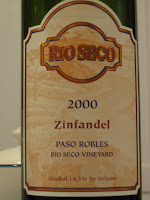
Appellation: Paso Robles
Varietal: Zinfandel
Stats: 14.3% ABV
Cost: ~$20, purchased at the winery in 2003/4
Appearance: Dark brick red, clear, good legs
Aroma: Chocolate, leather, blackberries, cassis, slight vanilla & caramel notes
Taste: Smooth, light tannins, low acid, cherries & raspberries dancing behind a curtain of leather & chocolate. Hints of mint in the smooth, lingering after taste.
This is an old Zin that I might have caught slightly past its peak. I discovered Rio Seco on a wine tasting trip to Paso Robles in 2003 or 2004 (same year that my ex-brother-in-law got married). Found it through a personal recommendation from another winery. They were a young winery at the time. Housed in a newly purchased building that had been used for illicit drug production (had the bullet holes for proof), I was fascinated that the owner/winemaker also was a former MLB baseball catcher and currently a scout for the Detroit Tigers. Fortunately, his wine was better than the players he found for the hapless Tigers! His wife gave us a tour of their facilities, including the vats of actively fermenting must. The smell in the tasting room/winery was pure heaven and probably one of the reasons that I ended up purchasing a case of wine! Seriously, I enjoy finding small, family-owned wineries that produce good wine for a reasonable price, and Rio Seco fits that bill to a T. Interestingly, the website currently lists the 2000 Zinfandel for sale. I'd suggest buying and consuming quickly because I think this wine is at its peak. A lovely old zinfandel that went great with a pumpkin/italian sausage pasta & green salad, it didn't hold up very long after opening--was pretty flat after 24 hr under vacuum.
Salute,
a Wine Student
State: California

Appellation: Paso Robles
Varietal: Zinfandel
Stats: 14.3% ABV
Cost: ~$20, purchased at the winery in 2003/4
Appearance: Dark brick red, clear, good legs
Aroma: Chocolate, leather, blackberries, cassis, slight vanilla & caramel notes
Taste: Smooth, light tannins, low acid, cherries & raspberries dancing behind a curtain of leather & chocolate. Hints of mint in the smooth, lingering after taste.
This is an old Zin that I might have caught slightly past its peak. I discovered Rio Seco on a wine tasting trip to Paso Robles in 2003 or 2004 (same year that my ex-brother-in-law got married). Found it through a personal recommendation from another winery. They were a young winery at the time. Housed in a newly purchased building that had been used for illicit drug production (had the bullet holes for proof), I was fascinated that the owner/winemaker also was a former MLB baseball catcher and currently a scout for the Detroit Tigers. Fortunately, his wine was better than the players he found for the hapless Tigers! His wife gave us a tour of their facilities, including the vats of actively fermenting must. The smell in the tasting room/winery was pure heaven and probably one of the reasons that I ended up purchasing a case of wine! Seriously, I enjoy finding small, family-owned wineries that produce good wine for a reasonable price, and Rio Seco fits that bill to a T. Interestingly, the website currently lists the 2000 Zinfandel for sale. I'd suggest buying and consuming quickly because I think this wine is at its peak. A lovely old zinfandel that went great with a pumpkin/italian sausage pasta & green salad, it didn't hold up very long after opening--was pretty flat after 24 hr under vacuum.
Salute,
a Wine Student
Sunday, December 20, 2009
Bedell First Crush 2007
I was cleaning off my desk a few days ago and came across some tasting notes that I could have sworn that I'd already written. However, a quick peruse through the archives says that I did not. I stumbled across Bedell on a 2008 spring trip to Long Island. At the time, this was about the only wine that I liked and was willing to pay their price (most everything else was really expensive). Enjoy!
Bedell 2007 First Crush
Country of origin: USA
State: New York
Appellation: North Fork of Long Island
Varietal: 82% Chardonnay, 18% Viognier
Stats: 12% ABV
Cost: $18 at the winery
Appearance: Light straw yellow
Aroma: Notes of pineapple and green apples with a melon finish. Very light & delicate nose.
Taste: Crisp & clean citrus and melon with a slightly acidic finish. There's a vegetative earthy undertone.
Salute,
a Wine Student
Saturday, December 12, 2009
Elk Cove La Bohéme Pinot Noir 2001
I couldn't get enough turkey over Thanksgiving so after spending the T-Day with friends (who brought out an amazingly complex 9 year old Napa cabernet), I cooked a turkey and trimmings for myself the next day. I was drinking a white wine while I was cooking all afternoon, but opened up one of my library wines to celebrate the dinner. The menu included turkey, the Powell special cranberry sauce, maple glazed roasted brussel sprouts with turkey bacon, and sourdough stuffing with italian sausage & mushrooms. And for the wine...
Elk Cove La Bohéme Pinot Noir 2001
Country of origin: USA
State: Oregon
Appellation: Willamette Valley
Varietal: Pinot Noir
Stats: 13% ABV
Cost: Unknown, purchased at winery in 2003
Appearance: Medium brick-red, good legs, clear, lightly translucent
Aroma: Dark cherries & vanilla, complex notes of leather, tobacco, & tar.
Taste: Silky smooth with muted dark fruit flavors of cherries & cassis. Finishes with complex layers of leather, tobacco, and cocoa.
Wow--that just about sums up this Oregon Pinot Noir. Amazingly complex & wonderful. Flavors that I'd normally associate with a cabernet sauvignon. The kind folks at Elk Cove Vineyards are nice enough to have historical tasting & viticulture notes on past vintages so we can glean a little more of how this wine was made. The 17 acre La Bohéme Vineyard was planted in 1985 on steep, south-facing slopes of well-drained Willakenzie soils with cuttings from the original estate Pommard vines. The vines are extensively pruned and cluster thinned to limit yields. Indeed, the 2001 harvest was a mere 1.9 tons/acre with Brix = 23.8 and total acids = 0.80%. After fermentation and aging in French oak, the wine was bottle with a total acids = 0.65% and pH = 3.62. Only 484 cases were produced. For those who keep track, this vintage received a score of 90 points from Wine Enthusiast magazine in 2003.
I visited Elk Cove in 2003 while I was on vacation. It was my first visit to the Oregon wine region and I fell in love with their pinot noirs. I visited a number of wineries on that trip, but I distinctly remember Elk Cove because it was the last winery of the visit. It's located in the hills of the northern Willamette Valley way off the beaten track. But it is well worth the trouble of getting there. The winery/tasting room was situated on the top of the hill overlooking the vineyards--an absolutely gorgeous spot as the sun was beginning to go down over the western hills. Elk Cove wines are pretty widely distributed, at least their larger base lines, and I've found them to be pretty consistent over the years since 2003. You may not be able to find the La Bohéme, but definitely try any of their wines that you can find.
Salute,
a Wine Student.
Elk Cove La Bohéme Pinot Noir 2001
Country of origin: USA
State: Oregon

Appellation: Willamette Valley
Varietal: Pinot Noir
Stats: 13% ABV
Cost: Unknown, purchased at winery in 2003
Appearance: Medium brick-red, good legs, clear, lightly translucent
Aroma: Dark cherries & vanilla, complex notes of leather, tobacco, & tar.
Taste: Silky smooth with muted dark fruit flavors of cherries & cassis. Finishes with complex layers of leather, tobacco, and cocoa.
Wow--that just about sums up this Oregon Pinot Noir. Amazingly complex & wonderful. Flavors that I'd normally associate with a cabernet sauvignon. The kind folks at Elk Cove Vineyards are nice enough to have historical tasting & viticulture notes on past vintages so we can glean a little more of how this wine was made. The 17 acre La Bohéme Vineyard was planted in 1985 on steep, south-facing slopes of well-drained Willakenzie soils with cuttings from the original estate Pommard vines. The vines are extensively pruned and cluster thinned to limit yields. Indeed, the 2001 harvest was a mere 1.9 tons/acre with Brix = 23.8 and total acids = 0.80%. After fermentation and aging in French oak, the wine was bottle with a total acids = 0.65% and pH = 3.62. Only 484 cases were produced. For those who keep track, this vintage received a score of 90 points from Wine Enthusiast magazine in 2003.
I visited Elk Cove in 2003 while I was on vacation. It was my first visit to the Oregon wine region and I fell in love with their pinot noirs. I visited a number of wineries on that trip, but I distinctly remember Elk Cove because it was the last winery of the visit. It's located in the hills of the northern Willamette Valley way off the beaten track. But it is well worth the trouble of getting there. The winery/tasting room was situated on the top of the hill overlooking the vineyards--an absolutely gorgeous spot as the sun was beginning to go down over the western hills. Elk Cove wines are pretty widely distributed, at least their larger base lines, and I've found them to be pretty consistent over the years since 2003. You may not be able to find the La Bohéme, but definitely try any of their wines that you can find.
Salute,
a Wine Student.
Sunday, November 29, 2009
Spier 2008 Sauvignon Blanc
While I'm reminiscing about my trip to Namibia, I'll add another note about some South African wines that I tried. Namibia was run by the South African government as a protectorate after World War I when Germany ceded control of its former colony. Lots of politics and bad history there, but even after Namibia gained independence in 1990, South Africa has remained as strong presence. Namibia gets most of its tourists, fresh produce, infrastructure, and wine from South Africa. Pretty much from the moment I stepped on the Air Namibia flight where they were serving a South African pinotage to the flight home, I was drinking South African wines. Fortunately, South Africa makes some pretty good wine, so it was all good! The first night in Namibia, my brother wanted to treat me to a traditional brai. Normally that word is simply translated as BBQ, but brai is not just a noun or verb, it's almost a way of life. It brings to mind visions of the early Afrikaaner settlers building a bed of charcoal in the middle of the veld and roasting hunks of fresh meat (beef or wild game). Real man stuff here--the hunt, meat, fire, beers, you get the idea... I missed my brother's big game hunt, so off we went to the grocery store to get some garlic wurst, toasties, and kebabs. To wash down our bounty, we bought some Windhoek and Tafel lagers (some of the best beer on Earth!) and a nice bottle of South African sauvignon blanc. The store did not have the greatest wine selection, but I rooted around until I found a bottle from the Stellenbosch region, one of South African's rising stars.
Spier Sauvignon Blanc 2008
Country of origin: South Africa
Appellation: Western Cape WO
Varietal: Sauvignon blanc
Stats: 12.5% ABV
Cost: Nam$49.40 or ~US$6.50
Appearance: Light straw yellow, crystal clear
Aroma: Tropical fruits, pineapple, melon, apricot, floral notes, and a light coconut finish
Taste: Crisp citrus and floral notes. Well balanced acid.
For you wine techies, here's a link to the Spier website with the winemaker's detailed notes. Overall a very nice welcome to Namibia and South African wines. Don't know how readily available this or other Spier wines are here in the States, but get out of the France & CA aisles and go explore the small South African section. You're likely to find a number of inexpensive, good wines.
Cheers,
a Wine Student.
Spier Sauvignon Blanc 2008

Country of origin: South Africa
Appellation: Western Cape WO
Varietal: Sauvignon blanc
Stats: 12.5% ABV
Cost: Nam$49.40 or ~US$6.50
Appearance: Light straw yellow, crystal clear
Aroma: Tropical fruits, pineapple, melon, apricot, floral notes, and a light coconut finish
Taste: Crisp citrus and floral notes. Well balanced acid.
For you wine techies, here's a link to the Spier website with the winemaker's detailed notes. Overall a very nice welcome to Namibia and South African wines. Don't know how readily available this or other Spier wines are here in the States, but get out of the France & CA aisles and go explore the small South African section. You're likely to find a number of inexpensive, good wines.
Cheers,
a Wine Student.
Saturday, November 28, 2009
Oysters & Champagne---In the Desert
A couple of posts ago, I alluded to trying oysters for the first time--in the middle of the Kalahari Desert along the coast of Namibia. Sounds too fantastical to be true? Well, guess again, it happened.
In October, I took a wonderful extended vacation and went to visit my brother and his family in Namibia. After a photo safari to the Etosha Pan National Park and getting far closer to lions and elephants than I would like, we headed for the Skeleton Coast and Walvis Bay/Swakupmond. One day we headed out for a boat tour of Walvis Bay and then a dune buggy ride through the sand dunes south of Walvis Bay in the Namib-Naukluft National Park. The boat tour is an interesting blend of the mechanical (Walvis Bay is the only deep-water port along the Skeleton Coast) and the natural (home to many sea lion colonies, bird sanctuaries, and Bengali dolphins that ride the bow waves of your boat). You also get an up close introduction to the burgeoning oyster fishery in the bay. It's still a small experiment, but one with great potential. They've found that the cold waters of the Bengali current that sweep north along the Skeleton Coast are so cold and nutrient rich that oysters grow to full size in 6-9 months compared to 3 years elsewhere. That's some fast growing!
The boat dropped us off on an abandoned pier along the tip of the bay where our dune buggy drivers were waiting for us. I swear these guys were transplanted stock car drivers! We went careening off up and down dunes that were 400-500 ft tall. After doing his best to get us to lose our lunches, Nick stopped for lunch. Here we are in the middle of the desert and this guy is breaking out the dining tables, chairs, champagne, and a bountiful buffet including none other than Namibian oysters. This was the first time that I had ever tried a raw oyster and I will admit to being rather trepidatious. The briny oyster juice was a little much, but the meat was one of the most tender & succulent things I have ever sucked down. And big! These oysters were almost handwidth in size.
They were paired with a very nice South African sparkling wine. I have no idea of the winery that produced it, but it was brut dry, crisp, toasty, and lightly citrusy. Delicious after a morning on the water and in the sand. We shared this feast with a few other folks from France, who didn't seem to enjoy the wine as much as I did. So I did my best to make up for them! Here's a picture of us enjoying the feast.

I'm the rosy cheeked guy with his glass at the ready! Who would have believed that I'd have a glass of sparking wine in the middle of the desert, let alone a feast of local oysters fit for a king!
Cheers,
a Wine Student
Friday, November 27, 2009
Sokol Blosser Evolution
I was wondering through Gordon's Wines & Liquor shop a couple of weeks ago in search of some viognier-based wines for a wine tasting that I was hosting, and came across this bottle in their "Other Varietals" section. Earlier this year, I read "At Home in the Vineyard", which was written by Susan Sokol Blosser and tells the history of the Sokol Blosser Winery. I enjoyed the book quite a bit because it talks about the struggles & triumphs of building a winery from scratch (I fundamentally disagree with Susan's seemingly cavalier attitude towards divorce as it spoke a little too close to home for me, but that's a side story). The final chapters of the book discuss the development and legal issues of the wine that became Evolution, so when I saw a bottle, I had to buy and taste it. Quite frankly--I was pleased that I had the opportunity to try this wine!
Sokol Blosser Evolution, Lucky Edition
Country of origin: United States
Appellation: Oregon
Varietal: blend of 9 varietals (riesling is definitely involved)
Stats: 12% ABV
Cost: $18 at Gordon's Wines & Liquor, Waltham, MA
Appearance: Light straw yellow, crystal clear
Aroma: Flowers! Pineapple, guava, & maybe some lichee fruit, with a final touch of apricots
Taste: The nose definitely repeats in this wine. Clean & crisp. Medium bodied white that leaves a pleasantly clean fruity taste on your tongue. Slightly sweet finish, although that is probably just perceived sweetness.
Sokol Blosser Evolution, Lucky Edition

Country of origin: United States
Appellation: Oregon
Varietal: blend of 9 varietals (riesling is definitely involved)
Stats: 12% ABV
Cost: $18 at Gordon's Wines & Liquor, Waltham, MA
Appearance: Light straw yellow, crystal clear
Aroma: Flowers! Pineapple, guava, & maybe some lichee fruit, with a final touch of apricots
Taste: The nose definitely repeats in this wine. Clean & crisp. Medium bodied white that leaves a pleasantly clean fruity taste on your tongue. Slightly sweet finish, although that is probably just perceived sweetness.
Thursday, November 26, 2009
Glenora Wine Cellars 2002 Cabernet Sauvignon
I needed to make some room in my cellar this month, so I started rummaging amongst the bottles to find some wines that I wanted to taste soon. Came across this gem that I've been looking forward to for some time.
Glenora Wine Cellars 2002 Cabernet Sauvignon
Country of origin: United States
Appellation: New York Finger Lakes
Varietal: Cabernet Sauvignon
Stats: 12.5% ABV
Cost: not sure on original price, but somewhere around $20 at the winery
Appearance: Big legs! Dark garnet color with slight bricking around the edge
Aroma: Black cherries, cocoa, & vanilla, with hints of leather
Taste: Muted flavors of cherries and strawberries with chocolate, leather, and a slight green pepper in the finish. Full bodied wine that lingers on the tongue.
This is an impressive red wine for a Finger Lakes red. I came across this during a visit to the Finger Lakes region a few years ago. While I was most impressed with the region's white wines, I was surprised to find a few reds that could stand on their own two feet. Being in the east, the area is vintage-challenged, meaning that each year can be very different from the previous year due to the weather. Some years are poor years for grapes, in other years, the stars align, the grapes ripen, and a great wine is born. 2002 was obviously a good year, and a full bodied, complex wine that cellared very well was born!.
Glenora Wine Cellars is one of the regions larger & fancier wineries, but they do make some good wine. They also have an inn & spa with a beautiful view of Seneca Lake just north of Watkins Glenn. I would strongly encourage everyone to make a wine tasting trip to the Finger Lakes area and enjoy the beautiful scenery and some very nice wines.
Salute,
a Wine Student
Sunday, November 8, 2009
Oyster & Wine--a "Shucking" Experience!
Yesterday I went to an Oyster & Wine "Shuck Fest" at Gordon's Wine & Liquor in Waltham. They had Island Creek Oysters shucking local oysters from Duxbury, MA and paired them with 23 different wines. I do have to admit that oysters are a recent like. I tried them for the very first time in the middle of the Kalihari Desert during a trip to Namibia. Wow! So, when I saw the notice for the Oyster & Wine tasting, I jumped at the chance to go.
It was a walk-around tasting event so I had to balance a plate of oysters, a glass of wine, and my tasting notes all at the same time. The oysters were delicious, but the line for the shuckers was so long that I gave up after a couple and focused on trying the wines. We were supposed to vote for which wine paired best with the oysters, but I had to abstain from judgement! I tried to focus on specific varietals at a time so I could make good cross comparisons.
First up was the champagnes & sparkling wines. I tasted three excellent French champagnes side by side:
Moet et Chandon Brut Imperial (mostly Pinot mineur) $45
Ruinart Blanc de Blanc (100% Chardonnay) $65
Veuve Clicquot Ponsardin (mostly Pinot noir) $40
My overall favorite was the Moet. Crisp, slightly sweet, nice creamy nose and mouthfeel. Tasting all three in a row allowed me to really pick out the differences in the nose and taste. The Ruinart had more toast notes from aging on the lees, while the Veuve had an interesting smokiness to the nose. But let's face it, I'm getting picky with three very good French Champagnes!
The second round was the sauvignon blancs:
Chateau de Sancerre (France--Bourdeaux), $26: restrained minerality, less fruitiness
Cloudy Bay Sauvignon Blanc (New Zealand), $31: Classic NZ sauvignon blanc, big citrus & lemongrass aromas. Two thumbs up!!!
Sauvion Muscadet Haute Culture (France--Loire Valley), $15: Nice & fruity
2007 Goisot St. Bris (France--Burgundy), $18: Limp & tasteless
Croney Estates Three Ton Sauvignon Blanc (New Zealand), $15: Excellent, crisp, big citrus nose.
Overall favorite--Cloudy Bay was the hands down winner. But, the Croney Estates was excellent for the price. Greg Crone, the winemaker, was there pouring. The 3 ton thing refers to the grape yield restrictions that he places on the vines to concentrate the flavors. I was very impressed with his wines. I bought a bottle!
Third round was chardonnay:
Croney Estates Three Ton Chardonnay (New Zealand), $15: More like a sauvignon blanc than a chard. No oak. Big fruity flavors. Clean
2006 Billaud Simon Chablis (France--Burgundy), $30: Smooth, nice crisp, mineral finish.
2006 Billaud Simon Chablis Premier Cru (France--Burgundy), $50: Even better!
I liked the Premier Cru the best, but again, for the money, the Croney Estates was excellent. I bought another bottle.
I also tried a couple of random varietals. The 2007 Stafford Hill Riesling ($15) from Oregon was one tart wine! And the Bartenura Moscato ($16) was a nice sweet wine to finish the whites. Too sweet for me to want to drink a bottle, but would make an excellent date wine. And I finished the day on the Croney Estates Two Ton Pinot Noir ($20). A little austere & restrained, but still a very nice pinot noir.
As you can tell, even though I didn't get to have many oysters, the afternoon was a smashing success! It was a lot of fun to try the champagnes together and the two quality levels of Billaud Simon Chablis side by side.
I highly recommend the classes and events at Gordon's. A good time is always had by all!
Salute,
a Wine Student
Thursday, November 5, 2009
A German Reisling Experience, Part I
Last month I took a MUCH needed vacation and went to visit my brother in Namibia. Where in the world is that, you ask? Well, it's on the western coast of Africa just to the north of South Africa--or about as far away from Massachusetts as I could get! My brother and his family have been living in Namibia since January, 2009 while he teaches wildlife ecology & conservation at the Polytechnic University of Namibia. For more details on his adventures, I'll refer you to his blog.
But getting from Boston to Namibia is half the fun of the trip. There are no direct flights from the US, so I had to hop a plane to Frankfurt, Germany and then switch to Air Namibia for the flight down south. Namibia used to be a German colony and it still serves as a big vacation spot for Germans and other Europeans. I was facing a 7.5 hr flight to Germany followed by a 10 hour flight to Namibia, so I decided to break it up and spend a few days in and around Frankfurt in between flights. Since Frankfurt is on the edge of several German wine regions, I wanted to try as many German wines as I could during my stay. The first evening in Frankfurt, I went for the beer experience with dinner and had a very nice local Pilsner and Dunkelbier at one of the touristy restaurants in the Aldstadt (Old City). The second evening, I found a wonderful fish market/restaurant called the Fisch Franke and had a wonderful broiled plate of salmon, tuna, and pike perch along with a Rheingau Reisling Kabinett. Don't ask me the winery because I didn't have my notepad with me during dinner, but it was a very nice wine with an acidic bite in the finish. On the way back to the hotel, I stopped into a local wine shop and found a very helpful salesman (who fortunately spoke English) who gave me a good recommendation for a bottle of premium riesling to sample back at the hotel.
Weingüter Wegeler Geiheimrat J Riesling 2006 QmP
Country of origin: Germany
Appellation: Rheigau
Varietal: 100% Riesling
Stats: 12.5% ABV, Spätlese Trocken
Cost: 16.80 Euros (~$24)
Appearance: Light straw yellow
Aroma: Light floral, pears, apricots, strawberries, and delicate citrus
Taste: The nose repeats on the pallate with a lightly crisp finish
Unfortunately, I didn't take a picture of the bottle and the winery seems to be constructing their webpage, but here's a link to a German wine site with a LOT of information on the winery. I really enjoyed this wine. For those of you who don't know much about the German AOC system, QmP is the highest level of quality. There are additional quality designations that are based on the sugar content of the grapes at harvest. Kabinett is the lowest level of sugar allowed at harvest, while spätlese is a late harvest when the grapes are more fully ripe and have higher sugar levels. There are about 3 more levels beyond that, but they quickly soar into the dessert wine arena, while kabinett and spätlese wines are often finished dry (trocken). This wine still has a low level of residual sugars (1.5 g/L glucose and 5/4 g/L fructose) but well within the dry category.
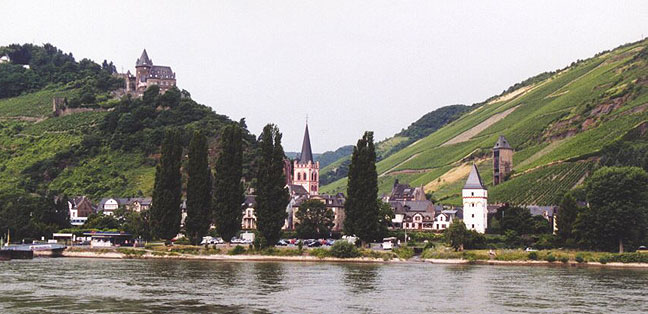
The Rheingau region is probably considered Germany's highest quality wine region and lies exclusively along the banks of the Rhine River between Kelsterbach in the east and Bacharach in the west. The Rhine River cuts almost straight east-west between these towns and the vineyards are almost exclusively on the north bank of the river where the steep, steep hillsides catch the most sun. I took a train ride along the Rhine and these are steep hillsides! I blatantly stole this photo from the web, but it shows how steep these vineyards are. Amazing!


Salute,
a Wine Student
But getting from Boston to Namibia is half the fun of the trip. There are no direct flights from the US, so I had to hop a plane to Frankfurt, Germany and then switch to Air Namibia for the flight down south. Namibia used to be a German colony and it still serves as a big vacation spot for Germans and other Europeans. I was facing a 7.5 hr flight to Germany followed by a 10 hour flight to Namibia, so I decided to break it up and spend a few days in and around Frankfurt in between flights. Since Frankfurt is on the edge of several German wine regions, I wanted to try as many German wines as I could during my stay. The first evening in Frankfurt, I went for the beer experience with dinner and had a very nice local Pilsner and Dunkelbier at one of the touristy restaurants in the Aldstadt (Old City). The second evening, I found a wonderful fish market/restaurant called the Fisch Franke and had a wonderful broiled plate of salmon, tuna, and pike perch along with a Rheingau Reisling Kabinett. Don't ask me the winery because I didn't have my notepad with me during dinner, but it was a very nice wine with an acidic bite in the finish. On the way back to the hotel, I stopped into a local wine shop and found a very helpful salesman (who fortunately spoke English) who gave me a good recommendation for a bottle of premium riesling to sample back at the hotel.
Weingüter Wegeler Geiheimrat J Riesling 2006 QmP
Country of origin: Germany
Appellation: Rheigau
Varietal: 100% Riesling
Stats: 12.5% ABV, Spätlese Trocken
Cost: 16.80 Euros (~$24)
Appearance: Light straw yellow
Aroma: Light floral, pears, apricots, strawberries, and delicate citrus
Taste: The nose repeats on the pallate with a lightly crisp finish
Unfortunately, I didn't take a picture of the bottle and the winery seems to be constructing their webpage, but here's a link to a German wine site with a LOT of information on the winery. I really enjoyed this wine. For those of you who don't know much about the German AOC system, QmP is the highest level of quality. There are additional quality designations that are based on the sugar content of the grapes at harvest. Kabinett is the lowest level of sugar allowed at harvest, while spätlese is a late harvest when the grapes are more fully ripe and have higher sugar levels. There are about 3 more levels beyond that, but they quickly soar into the dessert wine arena, while kabinett and spätlese wines are often finished dry (trocken). This wine still has a low level of residual sugars (1.5 g/L glucose and 5/4 g/L fructose) but well within the dry category.
The Rheingau region is probably considered Germany's highest quality wine region and lies exclusively along the banks of the Rhine River between Kelsterbach in the east and Bacharach in the west. The Rhine River cuts almost straight east-west between these towns and the vineyards are almost exclusively on the north bank of the river where the steep, steep hillsides catch the most sun. I took a train ride along the Rhine and these are steep hillsides! I blatantly stole this photo from the web, but it shows how steep these vineyards are. Amazing!
Salute,
a Wine Student
Tuesday, October 20, 2009
Kaz Vineyard & Winery Machismo 2006

Kaz Vineyard & Winery Machismo 2006
Country of origin: USA
Region: California
Appellation: Sonoma Valley
Varietal: 100% Counoise
Stats: 13.8% ABV, dry
Cost: $40 at the winery
Appearance: Light medium garnet, good legs
Aroma: Initial burst of vanilla & cherry with some black pepper and vegetal notes around the edges. A little dark cassis in the end.
Taste: Upfront sharp cherry fruit with a fairly tart cedar finish. Medium body.
I was rather intrigued by this wine when I visited Kaz Vineyard & Winery earlier this year. I can't say that I've ever heard of the grape varietal Counoise before and had to try it. Kaz describes it as a "studly" Pinot Noir with sharper fruit plus leather and cedar. I agree with the sharpness and cedar, but I'm not getting much leather in this wine. Wikipedia claims that the dark-skinned, but low tannic grape is grown almost solely in the Rhone Valley region of France (1580 acres), where it is allowed as a blending varietal in Chataueneuf-du-Pape wines. The Rhone connection is not a surprise since a Google search indicates that another Rhone Ranger winery, Tablas Creek, is the only place that admits to growing (5 acres) and using Counoise.
I've tasted this over 3 evenings. Night one was in a classic Bourdeaux-style Riedel glass, which did not showcase the wine. The flavors seemed tight and very in my face. I tried a Burgundy-style Riedel glass on the second night due to the pinot reference and found that much more to my liking. Granted, the wine had had an additional 24 hrs under vacuum to breathe, but the larger glass bowl seemed to give the aromas room to move and not deliver a concentrated punch to the nose.
Salute,
a Wine Student
Saturday, October 17, 2009
Loxton Cellars 2005 Cabernet Sauvignon
After getting off the plane from Germany, I felt like a nice glass of wine before heading to bed to sleep off the jet lag. I chose a bottle that I had picked up on a recent visit to Loxton Cellars earlier this spring. A relatively new winery, winemaker Christopher focuses on syrah and zinfandel (although he obviously makes a cabernet sauvignon, too!).
Loxton Cellars 2005 Cabernet Sauvignon Buffalo Bluff Vineyard
Country of origin: USA
Region: California
Appellation: North Coast
Stats: 14.3% ABV, dry
Cost: $26 at the winery
Appearance: Inky garnet with just a hint of brick along the edge. Massive legs.
Aroma: Massive fruity blast of cherries and blackberries. Hint of chocolate and coconut.
Taste: The blast of fruit in the nose repeats in the mouth along with a tannin chaser. Big, massive cabernet that wakes up your senses. Relatively nicely balanced considering the alcohol levels.
Notes from the winemaker:
Buffalo Bluff is a steep hillside vineyard north of Calistoga. It gives me some of the smallest grape berries I’ve seen and the challenge of this dry-farmed hillside fruit is to tame how big the wine wants to be. Aged two years in barrel and one year in bottle, this is a full-throttle mountain Cab that screams for a good steak. Big wine, sweet fruit, grippy Cab tannins; it’s like chocolate covered cherries and should age well. 187 cases produced.
Saturday, August 29, 2009
Westport Rivers Vineyard & Winery Tour
I just got back from spending a very rainy day visiting the Westport Rivers Vineyard & Winery in Westport, MA with ~20 other friends from my social club. Thanks to Tropical Storm Danny, we did not get to wander through the vineyards or taste on the lawn, but we did get a very nice in-depth tour of the winemaking facilities. Our tour guide, Craig, also gave us a very detailed walk-through of the winemaking process.
Those of you in New England (and other sparkling wine fanatics) may have heard of Westport Rivers. They are probably the best quality winery in Massachusetts, and are well known and regarded for their sparkling wines made from 100% estate grown grapes. I can hear the outcry--"It's too cold to grow grapes in MA!" Well, yes, the growing season for MA is short and is not well suited for the ripening of red vinifera grapes, but is actually quite similar to the climate of northern European grape growing regions like Champagne, Alsace, Chablis, and the Mosel & Rhine valleys. So just as those regions specialize in wines from white grapes that ripen faster, Westport Rivers grows only colder climate vinifera grapes, such as chardonnay, pinot gris, pinot noir, & meunier. Ah ha, you're sharp eyes correctly identified that pinot noir is a red grape, but Westport Rivers uses it to make sparkling wine and róses, not red wine.
Their sparkling wines are made in the "Traditional Method", or "fermented in this bottle." Since they ain't in Champagne, they can't legally say that the wine is made in the "Méthode Champenoise", but it's the same thing. A still base wine is made and bottled, along with a shot of sugar and yeast. The wine bottles are then tiraged, or allowed to rest for 3-14 years while the wine undergoes a secondary fermentation in the bottle. Once the winemaker determines that the flavors are what he's looking for, then the bottles are riddled (slowly turned) to allow the yeast solids to fall into the neck of the bottle. That solid plug is then disgorged and the champagne is ready for consumption.
After our tour, we tasted 6 wines. Unfortunately, 4 of their sparkling wines were sold out, so we only got to taste the 2003 Westport Brut made from 73% pinot noir & meunier and 27% chardonnay. A delightful crisp, drier sparkling wine with a lot of apple & pear aromas. We then moved on to the still wines and tasted the 2006 Chardonnay, Pinot Gris, 2007 Rosé of Pinot Noir, 2007 Rkatsiteli, and the Pineau de Pinot. All were quite good, but the Pinot Gris was my favorite. It's a blend of the 2006 & 2007 vintages with a big full body, wonderful aromas of pear, honey, and citrus, and a long fruity finish.
This was the first time that I've ever tried a Rkatsiteli wine. It's a white vinifera grape that was originally native to the Georgian region of Asia. Similar to a reisling or gewurztraminer, but not quite as floral. Big aromas of lemon and kiwi that ends on the tongue with a crisp citrus note.
The Pineau de Pinot was also an interesting wine. It's fortified wine of about 18% ABV almost like a sherry that's made by distilling a pinot noir wine. The distillate is then mixed with fresh pinot noir juice and aged in old French oak. Definitely a sipper along side a créme brulée.
I've wanted to get down to Westport for awhile and I'm very glad that I had the chance today. Fortunately, we were indoors during the worst of Tropical Storm Danny while we enjoyed some very nice wine. I like the wines so much that 6 bottles followed me out to the truck! I'll report on each of them in turn.
Salute!
a Wine Student
Subscribe to:
Posts (Atom)